
Supercell: The Clash Against Cannibalization
The Rise of a Mobile Powerhouse
Founded in 2010 and acquired by Tencent in 2016, Supercell has become one of the most successful studios in mobile gaming history. Supercell has produced highly memorable billion-dollar titles, including Clash of Clans, Clash Royale, Brawl Stars, Hay Day, and Boom Beach, generating over €11.0 billion lifetime revenue. Despite Supercell’s recent financial resurgence, reaching €2.8 billion in revenue in 2024, a 77 percent increase from 2023 , they faced significant revenue volatility between 2021-2023, suggesting an underlying structural issue.
Supercell Financial Performance (millions)

Industry Overview: Where Engagement is the New Currency
The global mobile gaming market, valued at over €117.0 billion, is projected to exceed €198.0 billion by 2030. Growth is driven by “live service” titles that depend on constant content updates and player engagement loops. The mobile gaming market is a “winner-take-all” environment, where the top few titles in each genre account for a disproportionate amount of revenues. High user acquisition costs also pose a large problem for even the most popular franchises, so success has shifted from launching many games to deepening engagement within existing ones.
The Problem: A Clash of Metrics
In 2025, Brawl Stars grew from 17.1 million to 24.3 million monthly players, while Clash of Clans fell from 53.9 million to 39.6 million over the same period. This is not a one-off occurrence but a recurring pattern in Supercell’s history, indicated by how interest in Supercell’s three main games has trended over the past two years. Industry analysts have long recognized this phenomenon. Deconstructor of Fun, a leading video game podcast, noted that while 2016 was one of Supercell’s most successful years, it was “likely fueled also by a cannibalization of Clash of Clans. Clans’ decline in Q1/Q2 ‘16 suggests that several players tried Clash Royale and then did not return to Clans”
Supercell Games Interest Trends

This trend of game-switching becomes even clearer when looking at Clash Royale’s 2025 performance. The game surpassed 210.0 million valid accounts, but most of its recent increase in activity came from returning users, not new ones. Between April and August, monthly active players increased from 34.0 million to 56.0 million, a 63 percent jump, while daily active users rose by 82 percent to 32.3 million. Yet only around 4.0 to 10.0 million new accounts were created during that time. While financials indicate increased revenue, a considerable portion can be attributed to Clash Royale’s recent surge, which temporarily re-engaged players.
New Clash Royale Accounts Created

The Progression Trap: Where the Grind Ends
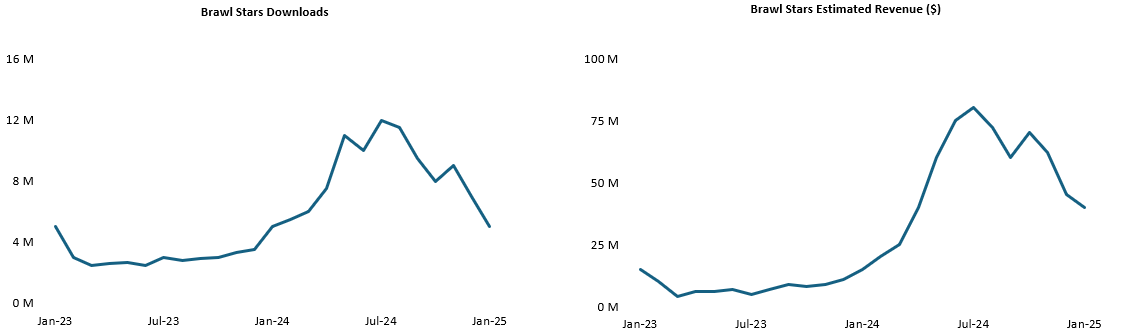
Player interest and time are the two main factors in driving engagement. Interest-driven cannibalization is proven when examining the dynamics between Clash Royale and Brawl Stars. There are two main factors that contributed to Clash Royale's resurgence in June 2025 and, correspondingly, the downfall of Brawl Stars: game-changing updates and content-driven virality.
Supercell introduced thoughtful progression changes to the game’s ladder system as well as a new internal strategy-based game mode, Merge Tactics. At the same time, Clash Royale exploded via social media platforms from popular content creator videos exhibiting novel gameplay. Brawl Stars began its decline in April and May 2025. Uncreative seasonal events and, more importantly, limited changes to the player progression system caused significant churn.
What should have been meaningful updates were substituted by the introduction of many imbalanced P2W features, further hindering advancement for many primarily Free-to-Play (F2P) players, aggravating the Brawl Stars community. Furthermore, content creators like SpenLC also highlighted these huge flaws in the Brawl Stars, further discouraging players. It is clear that players find it much harder to enjoyably progress in a game, nudging many players to either leave or switch games.
Brawl Stars Downloads and Revenue Trend
In the 2025 Clash Royale boom, the average player spends about 14 minutes per session and logs in four times per day, spending nearly one hour playing the mobile game. The nature of Supercell titles is short duration, with the average Clash of Clans and Brawl Stars game taking approximately three minutes. Players clearly have enough time to allocate across titles; they are just choosing not to.
Consequently, the cannibalization observed today is not driven by time scarcity but rather stale game updates that prevent reasonable progression and a sense of player achievement.
The Playbook for Long-term Growth
While supporting creative development in game updates is essential, Supercell must address the underlying issue of players feeling like their progression is limited while balancing monetization growth.
Current Cross-Progression System
Supercell would benefit greatly from leveraging its existing infrastructure that aims to promote cross-progression. The Supercell ID Rewards system exists to allow players to collect points across the various flagship games through a central account. Players can either accumulate points from completing weekly missions or making purchases for in-game items on the Supercell store. However, there are downsides.
Points are extremely hard to obtain. Across the three flagship games, the average amount of points players can get from completing missions in a month is 120, 100, and 120 points, respectively, across Clash Royale, Brawl Stars, and Clash of Clans. Based on various Supercell rewards, they were bucketed into Common, Rare, and Very Rare categories. On average, the rewards store allows players to claim an item after 16, 52, and 33 weeks, respectively, for the three titles, which is too long considering the game's aggressive churn rates.
As a result, the reward economy on the web app is misaligned with the in-game value that players are accustomed to. In Clash Royale, a 1-star Lucky Drop costs 350 points on the web app. For F2P players, earning 350 points requires roughly 2.9 months of completing every weekly quest, yet the same chest can be obtained on the mobile app simply by logging in and winning a single game. On the Web app, $1 of expenditure grants you 50 points. This means that for $7 of expenditure, users can exchange the points for a reward that can simply be earned by winning one extra game.
This gap between the in-game value and the web-app implied value removes any real incentive to engage with the web platform. Rather than completing quests for months, a player can win a single match and receive a Lucky Drop that delivers equivalent value. This imbalance makes the web-app progression system feel inefficient and discourages players from using it.
Supercell Rewards Times and Value

Redesigning Supercell Rewards
Connecting the Worlds
Supercell should interconnect missions across games. Supercell can first combine its existing “general” missions. The general missions include winning X amount of games, logging in X consecutive days in a row, and claiming X in-game rewards. The premise of completing a bundle of related missions is to reward players with a larger sum of points than completing those standalone missions.
General missions can only extend so far, which is why Supercell should also implement unique missions. This implies a need for an increase in the number of missions that award points. For example, a mission could be winning a certain number of games across the different titles using a specific brawler, troop or card. Supercell can leverage existing unique missions within Clash of Clans and Brawl Stars associated with the Battle Pass, as well as special events that accumulate and refresh every season. However, Supercell should consider implementing the same system within Clash Royale, so they can be coordinated across the Rewards system.
With an update that allows players to significantly increase their point balance means there needs to be a larger selection of rewards available through the cross-progression system.
Chasing the Legendary Drop
Generally, the rewards for the three core games should focus more on including items that are of actual value, which either focus on progression or prestige. Based on the rewards, Clash Royale and Brawl Stars both lack progression items, which are a key driver of player retention. The progression dynamics are different across the core games. Clash Royale is built around deck mastery and upgrading cards to the maximum level to compete against other players. Since upgrading a card requires collecting enough copies of that specific card, missions could help by rewarding players with either targeted cards or wildcards, which can convert into any card. Brawl Stars gameplay is based on a collection of brawlers, which can be upgraded with universal progression points and coins. Having missions that reward these specific upgrading mechanisms would be highly beneficial.
Supercell ID Rewards

Evidently, there is a limited number of coveted cosmetics in the Rewards System. Supercell should place more existing premium skins and emotes, as well as any similar cosmetics innovated in the future, exclusively in the Rewards Store. In addition, Supercell’s special events are a key driver in the sale of unique cosmetics. For example, Supercell introduced highly sought-after, one-time skins in special times like Halloween, Christmas, and Lunar New Year across its titles. These products were available for gems at a high price or could be obtained randomly in seasonal rewards. Supercell should change its offerings such that only players who complete certain weekly missions across various difficulties on all titles are able to unlock them. Not only does this add more prestige to their rare cosmetics, but boosts player engagement.
Maintaining Positive Elixir
Supercell finally needs to assess whether the new interlinked missions and rewards in place are feasible. Supercell should monitor the impact of the increased number of points that change player activity over time. This strategy can be explained using the dynamics of Brawl Stars and Clash Royale. If Brawl Stars has lower player activity than Clash Royale, the Rewards System could generate more missions tied to Brawl Stars. Players who have already completed most of the progression ladder in Clash Royale have other means to continue progression. If cross-game missions help them progress in Clash Royale, players may become more open to buying progression items and eventually cosmetics in Brawl Stars once their interest returns.
Marketing: The Meta Game
Popular Clash Royale content creator, Mr. Clash Broyale, said, “Clash Royale isn’t driven by common updates, it’s driven by the Creators that play this game”. Supercell already has extensive user-generated content with a community of both casual and pro player-based content. Supercell should also focus on building more partnerships with streamers and content creators on other games.
We have seen the importance of creator influence. Jynxzi, a viral Rainbow Six Siege streamer, started playing Clash Royale around May, which caused a surge in interest in the game. Jynxi was able to contribute to so much growth because he reignited the interest in veteran players and introduced some new players as well.
Supercell content creators will naturally advertise the new Rewards System. However, having new gaming content creators similar to Jynxi who can show how the Rewards System has helped them progress from level one would clearly exhibit the benefits of cross-playing games.
Securing the Three Crown
Supercell has recently announced some conflicting updates for Clash Royale and Brawl Stars. Clash Royale confirms a new progression model, including the addition of a new card level and altering other upgrading mechanisms, which could make progression once again more difficult. But with a cross-progression system, these effects can be significantly mitigated and can even re-expose the player base to Brawl Stars, which has some highly anticipated updates.
Moreover, the unified cross-progression system will be crucial in revitalizing the entire Supercell portfolio. It directly incentivizes players to experience all flagship games, using activity in one title to advance progress in others. When supported by consistent high-quality updates by the Supercell development team, this model will sustain higher overall engagement and better convert voluntary player purchases into a stable, long-term revenue stream.
Editor(s): Shalin Ratti
Researcher(s): Liangray Li
